Addiction Recovery and the 12 Steps: You Don't Have to Hit Rock Bottom
With Jon Sommervold, Executive Director of Tallgrass Recovery and Sober Living Homes - Sioux Falls, SD
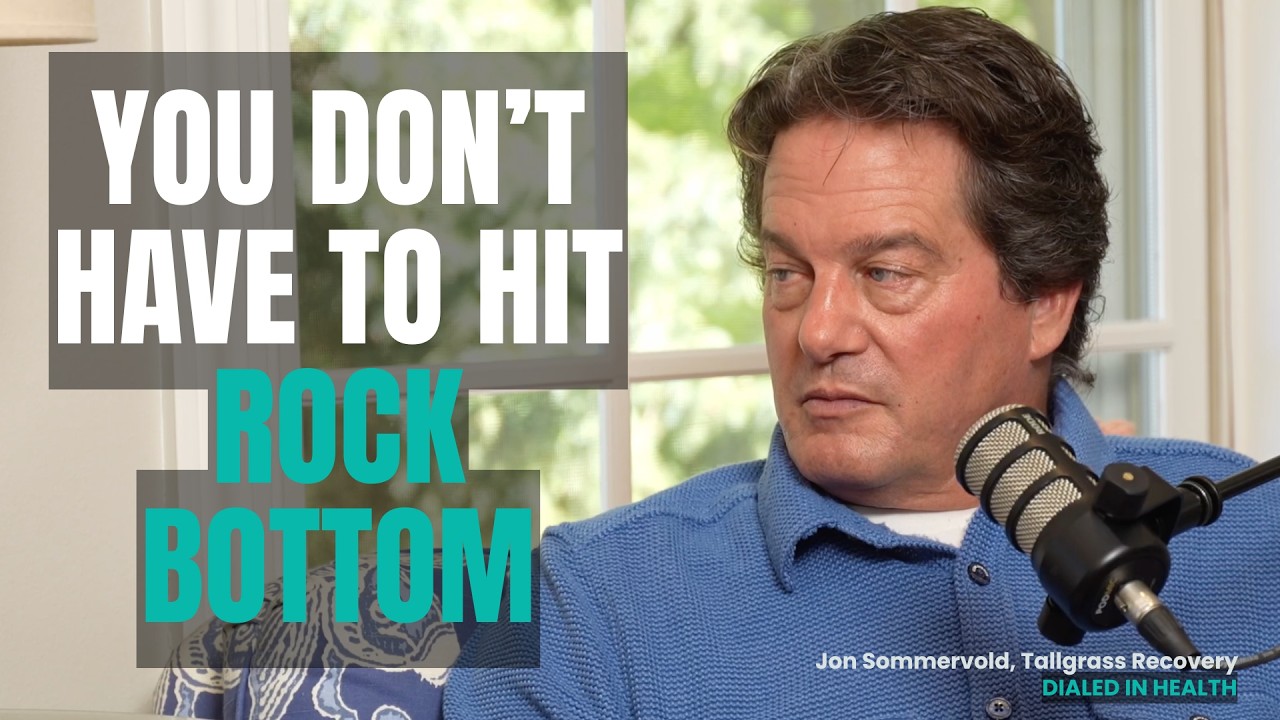
No, you do not have to hit rock bottom to get sober. Jon Sommervold, Executive Director of Tallgrass Recovery and Sober Living Homes in Sioux Falls, South Dakota, has been sober 28 years and runs a 30 night 12 step immersion program with roughly a 50 percent success rate, when the national average is closer to 10 percent. His safer framing is choose your bottom: if your life looks fine on paper but feels crushing, that is enough of a reason to start. In this episode he explains what a higher power really means when you are not religious, the honest difference between heavy use and addiction, and how to help someone you love.
You do not have to hit rock bottom. Jon Sommervold rejects waiting for a bottom and says choose your bottom instead. If life looks fine on paper but feels crushing, that is a fine stepping off point.
Choose Your BottomThe 12 steps are spiritual, not religious. There is no hierarchy, no test of how you pray, and atheists are welcome. A higher power can be anything greater than you that loves and forgives you.
Higher Power, Not ReligionHeavy use versus addiction comes down to one honest question: when you start, do you stop? About 90 percent of people can drink normally. For the other 10 percent, drinking sets off a loss of control they cannot will away.
Heavy Use vs AddictionThe opposite of addiction is connection, built on honesty. It is called a program of honesty for a reason, because you cannot feel connected while you are lying, even to people who love you.
Connection Over SobrietyImmersion is why Tallgrass reaches roughly 50 percent when the national average is closer to 10. Every staff member lives in recovery, each resident gets a mentor through the first seven steps, and they see recovery modeled every day.
Why Immersion WorksWillpower does not beat addiction. A person can have a thousand times the willpower of a normal person and still relapse, because it is a disease that overrides will, not a moral failing.
It Is a DiseaseFamily members are the hardest voice for an addict to hear, which is why interventions seat the closest person last and why Al-Anon exists for the people who love someone struggling.
Families and Al-AnonDo you have to hit rock bottom to get sober?
No. Jon Sommervold rejects waiting for rock bottom and says to choose your bottom instead. If your life looks fine on paper but you feel crushing fear, guilt, and shame, that is a fine stepping off point. Searching for a lower bottom, he warns, is dangerous because addiction can be fatal.
Are the 12 steps religious?
No. The 12 steps are spiritual, not religious. There is no required faith, no hierarchy, and no test of how or whether you pray. A higher power can be anything greater than yourself, even an atheist's sense of unconditional love or simply the fact of a meeting. Many people return to their own faith later.
What does higher power mean in the 12 steps?
It means any force greater than yourself that you choose, defined only by being something that loves and forgives you. It does not have to be God or a religion. Sommervold's own first higher power was the fact of a meeting, a room of people staying sober when he could not.
What is the difference between heavy drinking and addiction?
The honest test is control, not quantity. Sommervold asks: when you start, do you stop? Do you stop at blackout, at a fight, when the money or friends run out? About 90 percent of people can drink normally. For the other 10 percent, drinking sets off a loss of control they cannot will away.
Why does Tallgrass Recovery have a roughly 50 percent success rate?
Because it immerses people in a 12 step community instead of treating them in isolation. Every staff member lives in recovery, each resident gets a mentor through the first seven steps, and they hear two or three speakers a day for 30 days. People succeed, Sommervold says, because they see recovery working over and over.
How do you help someone you love who has an addiction?
Do not stop showing up, and do not rely on passive or passive-aggressive hints. Sommervold suggests honest, non-judgmental questions like Are you getting what you want and Are you okay. Family members are often the hardest people for an addict to hear, which is why outside community and intervention help.
What do you say to someone who does not think they have a problem?
Avoid accusations. Ask whether they are getting what they want out of life, and tell them what you want for them is to get what they want. Point out gently that from the outside they seem unhappy, then ask whether they would like to meet people who have found a solution.
What is Al-Anon?
Al-Anon is the 12 step program for people who love someone with an addiction. Its purpose is to help you learn that you cannot control another person's using, and that they do not have to be a thief of all your joy. Sommervold calls it an essential program, valuable whether or not your loved one ever joins recovery.
Is addiction a moral failing or a lack of willpower?
No. Sommervold says a person can have a thousand times the willpower of a normal person and still relapse, because addiction is a disease that overrides will. Immoral things can happen during use, but willpower has never stopped the disease. Treating it as a character flaw leaves people nowhere to go.
How do you start at Tallgrass Recovery?
Call the campus at 605-368-5559, where someone in 12 step recovery answers and points you to the next step, even if that is somewhere other than Tallgrass. You can also reach out through tallgrassrecovery.org. Sommervold's one instruction is simple: make the call.
The 12 steps are a religious program.
You have to figure out what you believe before you can get sober.
If someone loves you enough, they will quit for you.
Addiction is a moral failing or a lack of willpower.
You have to hit rock bottom before you can get better.
MELISSA Maybe you have seen a loved one disappear in front of you. They might still be in the room, still breathing, but the person you knew is gone, and you don't know how to get them back. Maybe it's your son, your daughter, or a husband, a friend you grew up with, maybe it's you. And every search you do at 2 a.m. plans you somewhere that doesn't feel real. Glossy rehab websites, influencer pep talks, religious answers from people who don't seem to know what addiction seems, feels like from the inside. So today on Dialed In Health, we're gonna be sitting down with someone who does know it from the inside. I'm with Jon Sommervold, the Executive Director of Tallgrass Recovery and Sober Living Homes right here in Sioux Falls. Jon's lived this, he's worked the steps himself. He now runs a 30-night, 12-step immersion program with roughly a 50% success rate. And the national average is around 10%, so that's a pretty incredible success rate. And that's not a marketing line, it's what happens when you stop selling rehab and start building community. In today's episode, you're gonna walk away knowing how someone actually gets spiritual when they get sick with addiction and what a higher power actually means in the 12 steps. What to do with religious baggage and the hypocrisy that has turned so many people away. And the difference between heavy use and addiction, what to say when someone who does not think they have a problem, and exactly how the process starts at Tallgrass. Health and wellness is confusing. There's a new trend every week. Everyone's got an opinion, and half the time, you can't tell what's legit and what's just good marketing. And we get it. We're in it too. Welcome to Dialed In Health. I'm Melissa Goodwin. Every episode, we bring in the people who actually do this work, providers, practitioners, the experts who see clients and patients every day. We ask the questions you'd ask if you were sitting across from them so you can find the right people, make better decisions, and feel confident about what's out there, whether it's peptides, gut health, water quality, ADHD, biohacking, or something you've never heard of, we're covering it. So let's get into it. Let's get Dialed In. So today, I'm sitting here with Jon, welcome Jon to the show.
JON Thank you very much.
MELISSA So maybe you can start by just telling us a little bit about your story. How did you become the executive director of Tallgrass? I know it's not a simple line, right?
JON Yeah, there's no degree in that. So I was a volunteer at Tallgrass telling my story. I started volunteering there when I was sober about 11 years. I stepped in to visit a friend who was there and he had already decided it wasn't for him and left. And so the volunteer coordinator is like, well, how are you meeting your 12 step obligation? That 12 step is to bring this message to the alcoholics. And I said, well, I sponsor a few guys, I do things. Now you're gonna do the Wednesday meeting here, second Wednesday of the month. And I did the second Wednesday of the month for nine years before I started working there. And when I started working there, there were two questions and that was who's gonna take the second Wednesday of the month and bring me a puppy. I did both, I kept my day until COVID and I brought my puppy. So I got to, so I volunteered for years and then I was on the board. And when I was on the board, they said, well, you think you're so smart, why don't you do it? And I snuck up on them and said, yes. And but the path to that, because every single person who works at Tallgrass is living in 12 step recovery because we can't lose the first three questions. You don't know how I feel, how do you know this works? And how do you know it works here? We can't lose that. 12 step recovery journey starts in the summer between third and fourth grade, smoking marijuana at Tuthill Park, adding alcohol in eighth grade. And now it almost cured me right then. The first time I ever drank with the exception of one pull by my best friend, I drank the rest of a 750 at Gilby's Gin, five, four, 123 pounds worth of eighth grade man. And I got terribly, terribly sick and never had gin again in my life. But I found substitutes and prior to getting super sick, that anesthesia was exactly what I wanted. I mean, I felt that, I was like, oh, this is the thing. And I went on to anesthetize myself aggressively until I was about 30. What was anesthetizing? Well, for 10 years, from age five to age 15, I was habitually physically sexually abused by a friend of the family every time he was in town. And it was 1973. And so when you go to your parents and say, this is happening, the response was not, oh my gosh, we're gonna help you. It was, how dare you? How dare you say that about anyone? We've known them for generations. years later, I don't begrudge that response. It was so out of this world. What I was saying was so out of this world, so out of their paradigm that they responded the best way they knew how. And I went on anesthetizing. And I added more and more aggressive street drugs as we went, all while doing normal things, graduating from high school, graduating from college, having a job, getting married, staying married, starting to, I got sober after our first child was born and while Kate was pregnant with our middle.
MELISSA you told your parents, which many people don't, I would think that would be hard to wrestle with.
JON Well, forgiveness is a decision. There's no way to earn it. They can't earn it. No one has a time machine. I believe that they were doing the best they can. And I believe that they loved me. And between those two things, we're all better off if that doesn't become the thing that I ride the rest of my life. You know, my dad and I never got along because he didn't like me. And it was not a secret. Excuse me, one of the last cognizant conversations we ever had, he turned to my son's, we were watching a football game and he was not there. He had Alzheimer's late in life. Then all of a sudden he was very cognizant and very present and he said, "Now boys, I hope you've found a better example than your father." And, you know, they are sort of, think they're funny and they're right. So they lean forward. "Well, grandpa, tell us about that." "Oh, he had 10 minutes of stuff." He told them all about it. And we were walking out and they're like, "I'm really sorry that happened." I said, "It's okay." The example here is that that wasn't a surprise and still we, you know, we love him and we make sure he's okay. know, he, my whole life, he only said really three things to me. You can't know that. Other than you think that's a good idea and show me that in writing. Tough way to be a first grader. And I always thought that was some deep resentment where he was trying to undermine me. And then I'm 48 years old and he calls and he says, "I need a ride back from Phoenix because you can't drive long distances." And I go down get in the car and I have a Steven Ambrose book that's an hour longer than the drive. I'm ready. And we get about six miles outside of Phoenix and he turns off the stereo in the car and he says, "I can't understand a word that guy's saying." And I said, "Where are your hearing aids?" Well, they're in the trunk. Who am I gonna talk to? And I'm like, "Oh my gosh." And then dig for some Dale Carnegie training. He asked me about formative things in their lives. "Dad, when you first started out as an attorney, what was the big thing? What happened?" The big thing was that he got the job because he was the boss's son-in-law and they put him in a closet and he gave him no work and he read railroad law for 13 weeks, nothing else. And then a case comes in and it's bad. It's a terrible case and it rolls all the way downhill to Arlo. And the CEO of the Chicago North West Memorial walks in and says, lays out the facts. And my dad says, "That's fantastic. We can do this, this, this, and this." And the CEO says, "You can't know that. Other than you, who thinks that's a good idea. And show me that in writing." And I built my whole, he built his whole career on that. Represented them for 55 years and gave me context on what he'd been telling me when I was 48 years old. Sort of took away my shtick. My dad was mean to me. No, my dad was loving me the best way he knew how. He was terrible at it. And he just didn't communicate well. an adult person, my job is to accept the grace that my power has given me and pass that grace along to others under the premise that they're doing the best they can with what they have right then.
MELISSA So many people have complicated family dynamics and kind of talked about yours there for a second. Did you try other programs or was the 12-step program the first one that you went through?
JON Well, I tried. I tried every medical thing.
MELISSA Okay. Like, okay.
JON Like like pills, like admonitions, lots of people just stop that. You're a bright young man. You know better.
MELISSA Sure.
JON Come on.
MELISSA Times were different in the 70s and 80s and even the early 90s.
JON Well, I mean, it's not different now. The status of South Dakota is putting people on Suboxone when they get out of prison who aren't opiate addicts.
MELISSA Because?
JON Well, I would hate to speak to their motivations, but we want to pill for things.
MELISSA Sure, easy.
JON We want to pill. And if we have a pill, then the system keeps rolling. Everybody keeps getting paid. And the person doesn't have to have the personal responsibility of growth. We really other them. And that's sort of my version of most of the medical approaches to addiction is you're othering that person. Because I'm gonna give you this, you're gonna take it for the rest of your life. There's strong evidence that it causes the same damage as the drugs you're taking now, but at least it's a prescription. it's the best you can do because you're an addict. Well, I'm an addict and an alcoholic. At the end of my addiction, I was a daily alcohol, cocaine and heroin user. By any estimation, clearly an addict. If I didn't drink by 10, 30 in the morning, I couldn't control my hands at all. I couldn't sign anything. Turns out that one of my coworkers was an excellent drug dealer. And I was not sentenced to a lifetime of that by the system because I didn't enter the system. And some of those drugs, like have been around as long as I've been sober. You know, I've been sober 28 years. I just think that we're othering them badly by deciding the best they can do for them.
MELISSA So how is the 12-step program, do you think different than other recovery programs? What is the, what's the thing that will--
JON Well, the big recovery programs, well, some are not recovery programs. They're maintenance programs. Methadone is a maintenance program. Suboxone is a maintenance program. There's no endpoint where the person can live without some sort without something influencing their brain. Then you have cognitive behavioral therapy, which is the most common sort of chemical dependency counseling. Cognitive behavioral therapy, according to John Kelly at Harvard, works about 61% less of the time. Because it's a tough ask. You know, your brain is largely broken in your addiction. And so now we're going to use your decision-making ability to make better decisions. Well, I'm incapable of that. I think that's a huge ask for the addict. Think it through. What do you think has been happening? I don't know a single addict who's ever thought, well, yeah, this is what's best for me. It's this is what I do. This is what I have to do. This is how I don't die. Because in the throws, it's not a problem, it's a solution. no small wonder that with a success rate of eight or 10%, it's because you're asking for the impossible. You're asking for the person to fix themselves. Just no more.
MELISSA So you've been doing this work. You've been sober for 28 years. And you said part of the last step is to help others who are addicted.
JON Having had a spiritual awakening, we bring this message to the alcoholic. Having had a spiritual awakening, we bring this message to the alcoholic.
MELISSA Okay. That's the last step. So you've seen all kinds of things, I would imagine. What makes Tallgrass? How do you have a 50% recovery rate when the national average is 10?
JON Because we immerse people in 12 step recovery. In 12 step recovery, the only variable is the person. 12 step recovery works. The variable is do you stick with it? In the beginning of the big book, it says, rarely have we seen a person fail who has followed these steps. When they first wrote it, they said never. Little strong. But rarely have we seen a person fail. And to the extent that we can actually give ourselves to the program and do it, the variable is not the program. It's the participant. And the reason Tallgrass works is because they see 100 examples of it working. The whole staff is in 12 step recovery. They will see us at meetings. They see us at the meetings that we take them to. People who are not on the clock are still at the meeting. Everybody gets their own mentor who takes them through the first seven steps. That mentor is someone in recovery who has just worked those steps. They have two or three speakers a day, every day for 30 days who will come in and share their story, work through a part of the big book of Alcoholics Anonymous with them. And they see examples over and over and over of the fact that it works. Then, we invite them when they, if you come through Tallgrass, you can come back for a meeting or a meal forever at no charge. So we invite them to be part of our community and we immerse them in the recovery community in the city. And to the extent that you stay engaged, you have a spectacular chance.
MELISSA So what is it specifically, you mentioned a little bit about your history and there's all kinds of things that happen to us, good, that are terrible and awful. What is it about the 12 step peace around religion that people really fight the most?
JON first off, they think it's religion. It's not. One of the best speakers I ever heard, Bart R. from Stewart, Florida, said I have the higher power of my misunderstanding. Because if I could fully understand him, he'd only be as big as I am. And that's not big enough to save me. Bart is an avowed atheist. He has no God consciousness. He has a higher power. There's no religious aspect. Because there's no religious structure. There's no proclamation of faith. There's no metric where someone else decides if you have a God or not. It's not how it works. First off, there's no hierarchy in 12 step recovery. Our leaders, as it says in the book, our leaders are but trusted servants. They don't govern. You can't get kicked out because you pray wrong.
MELISSA So I think-- And you don't get promoted because you pray more.
JON No, no. In fact, we don't have to know. I don't have to know how or if or when you pray. I'm not here to decide if you're sober or not. I'm here to go to a meeting with people who have the same disease I do and are now experiencing the same promises and recovery that I am. It's a privilege. for a lot of people, when they first started, when I first came into 12 step recovery, I had zero faith. And I think that was an advantage. With zero faith, my first higher power was the fact of a meeting. Because I'm in a room with 45 people that frankly I looked down on. Don't they know who I am? With 45 people I looked down on who were all accomplishing something I could not accomplish. They were sober and they were happy. My first meeting is 12 years before my sobriety date. I was terrible at this. And they all had something I didn't have. And I didn't mean to deal with what it was. But that, that couldn't have been them. That had to be a higher power. Because I can't be below all 45 of them, come on. So that had to be a higher power. And that was my first higher power. My first higher power was the fact of a meeting. The fact that I went into a place where people greeted me, wanted me to come back even after they knew me. And meant it.
MELISSA That's always the correct, no matter what group you're in.
JON Yeah, my first sponsor, I was ruining the meetings because I knew things. And so he walked across after I'd ruined about eight in a row and he said, hey, I'm your sponsor now. And I said, I didn't have my sponsor. And he said, I know that, but I don't know how else to get you to shut up. Because I had nothing to offer, but I was offering all the time. And the fact that a man who had no need of me at all, he'd been sober 30 years. He had, and he knew everyone in the room and their kids. He had such a full and beautiful life just to watch it. I of course deeply resented it. Clearly he couldn't have real problems. Look how happy he is. And that he walked across the room and just said, I'm going to help you if you're willing to help yourself now.
MELISSA You have a lot of people in your program. They're there for 30 days. There's 12 steps. Like, I don't know, like two and a half steps a day or something like that. How do you know that they've completed what they need to complete to be successful when they leave after that 30th day?
JON Well, knowing is strong language. I have a very, very low prediction rate. When I look at people who are coming in and leaving, I've tried to stop guessing because I do not know. One of the big dangers is being like a treatment center rock star. Look at me, look at all the things I can do. I did all my homework. And for some reason, that person struggles way harder than the person who fought tooth and nail for 23 days and then in the last six days thought, "I have some work to do." It is not a regimented, okay, you're gonna spend these two and a half days on this step and these two and a half days on this step and these two and a half days on this step. We're only going through step seven.
MELISSA Which is what?
JON Let's talk about the steps just a second. Step one is not, I'm an alcoholic. Step one is, we came to leave for powerless over alcohol and our lives were unmanageable. That's different than I'm an alcoholic because it's a sense of powerlessness. My problem, there's no part of this program that will teach me how to stop drinking and no part of this problem that will teach me how to drink less. Drinking or not drinking is a decision and the question is how do I live that way? So I'm powerless over alcohol, true statement. Also, peanut butter M&Ms. I can't have one. The dopamine just trips and I'm off to the races. They will be gone. Alcohol is the same way. All, every, so I'm an addict. I'm powerless over it so I can't stop. It's not the fourth one, it's the first one. Second step is, came to believe a power grater than myself could restore me to sanity. I was offended by that in the beginning. Sanity, what do you mean? Well, you've been doing the same thing over and over expecting a different outcome. That's the definition of. So came to believe a power grater than ourselves could restore us to sanity. It does not say, came to believe that if I go back to church, I'll be okay. It says a power greater than ourselves. The fact of the meeting, the fact of 12 steps. I sponsor an avowed atheist who his higher power is the unconditional love he felt from his grandparents. He'll be sober 10 years in September. And I know he's not cheating and slipping into church on Sundays. It's just not a religious program. It's a spiritual realization that something in the world is bigger than I am. And if I right size myself to the universe, I've made huge progress. Step three is turn my life and my will, turning my life and my will over to the higher power of my understanding. That might be the program. That might be meetings, whatever you choose. About 75% of people in Alcoholics Anonymous or 12 step recovery go back to the faith tradition they grew up with. Most of them have a slightly different perspective on it when they return. I did not return to my denomination. I did return to Christianity, which I fought aggressively against for years. So step three is to turn my will and my life over. Well, why would I do that? Well, the real answer is because look, being in charge of myself got me. And a part of that is realizing that you're not getting what you want. Because if you're getting all the things you want, there's no reason to, why would you stop? If you're not getting what you want, well, then maybe you shouldn't be in charge. So then step four is a fearless and searching moral inventory because what's driving my behavior? And it's not a list of things for which I can't be forgiven, and it's not a list of things for which they can't be forgiven. It's a list of things about which I still have emotional energy and resentments because those impact my relationship with myself, my higher power and everyone around me.
MELISSA Yeah, seems like a tricky one because you may or may not know what all your resent, like you might, some of them might be very-- It's not a one and done. Yeah.
JON I have a group of guys who come over on Wednesdays and during the year, during the school year, we read stories out of the big book, but during the summer, we do all 12 steps, one week. Okay. 28 years in, still writing out a fourth step, still writing out, then doing a fifth step with my sponsor who says the same thing at the end of every time, which is, so really your trouble is your ego and your pride. And the answer is yes, that is really my trouble. So no, there's no perfect fourth step, there's no final fourth step, but let's have a conversation about what things are driving you and the way you treat yourself and others. So my first fourth step, who was I mad at? I was mad at me, I failed over and over. I was mad at God, because he let me. And I was mad at the people who abused me and I was mad at the people who didn't stop them from abusing me. I was mad at everyone. Well, so I had those resentments. Now, those resentments create character flaws. So what were my character flaws? Well, I was at a hypersexual approach to life, and I was very combative against any sort of authority. And those are character flaws.
MELISSA So-- I have number two. I don't know why people tell me what to do.
JON You're not the boss of me. And as a result of that, my life looked like that. Sure. And I'm pretty sure that that's not what my higher power wants for me. So step five is to share that with yourself, because you've been hiding it, with your higher power, because you're asked for a little help, and with another human being. And a part of that is so that they can hear your story and not spontaneously combust. So you're not terminally unique. And a part of that is so they can help you identify your character flaws, because, or defects of character as they say, because in step six, we're going to become willing to ask God to remove these defects of character. So a whole step on just being willing. Well, why is that? Well, because I want to defend most of my defects of character. First off, it was most of my personality. And that's a tough realization. Step seven, actually ask God to remove the defects of character. Why? Because they're impediments to my relationship with my higher power. And if I'm going to pretend in step three, and a lot of step three is pretending over and over. If I'm going to declare to myself that I'm turning my will in my life over my higher power, and I have to remove the things that separate me from my higher power, which are my character defects. So in step seven, I actually ask God to take all of the good and the bad. And it's a small G God, usually. And sometimes it's a capital G God, and it's okay either way, because there's no test.
MELISSA Yeah. I'm curious, you said number three is a lot of pretending. Tell me about that. Got a line for ourselves. Because I think there's a lot of folks that really struggle with the, for whatever religion, God, there's a lot of folks that really struggle with that for a lot of good and bad reasons. Tell me about that pretending piece. What does that do for you? Why is it so important that you pretend for a while? Does it ever become real?
JON Well, my use of the word pretend was in reflection, not in intention. So it turns out that a lot of the time, when I think I'm turning my will in my life over, I'm just rationalizing and getting my way. That's pretending. Also, a lot of the time, when I want to shape how people view me, then I run the risk of pretending also. But to take it back a step, that sort of fake it till you make it thing, can be very valuable because it's not a thinking program. There's no spot in the big book where it says, and then Billy Bob thought about. It's what did Billy Bob do? So what is our next right action? Not what is our next right thought? So I'm gonna turn my will in my life over to God, the higher power of my understanding. I mean, the only way I can think of to do that is in situations where I have to make a decision, ask what the right next action would be. What is the right next action? Does that make me servile and scraping before some omnipotent being? I don't think so because the higher power of my understanding does not want to harm me, does not want me to be less than I am or can be, does not want me to be unhappy or lonely or any of those things. So when I have to make a decision about my will or God's will, it makes perfect sense to ask to understand God's will in that moment, what is the next right action? And the problem with prayer is it works. I mean, so when we talk, people wanna have the fight. I'm not gonna just give in to some God of yours. Well, good, because it has to be yours. It's your power of your understanding, not mine. They may not be similar at all. The only advice I would give about your higher power is make it one that loves you and forgives you. Don't just get one who's gonna drop you down. That's a terrible idea.
MELISSA Yeah, I don't want that one either.
JON But you don't have to define, but that's the only definition, loves you and forgives you.
MELISSA Do you ever see people just pretending, going through the motions so they can get through the program?
JON All the time. And then the program sneaks up on them and it works.
MELISSA Okay.
JON Because it's not a thinking program. It's a program of action. On page 552 of the big book, there's a great lesson. And it is the most dangerous thing for us in recovery is resentments. And just hating on anyone or anything is dangerous. From the standpoint of never using again.
MELISSA So why is that so dangerous? Tell me about that.
JON Because if we can indulge ourselves in anger and resentment, we can indulge ourselves in anything. Because it's a false sense of righteousness. That person did this to me. Well, so therefore I can, or therefore I don't have to, or therefore, look, they made me an addict. And that's what I am. So now you can do anything. it says is, if you have a resentments against someone, pray for that person for 14 days. Pray whether you want to or not, pray whether you mean it or not. Pray for them to get exactly what you want for yourself, your outcomes, everything. And at the end of 14 days, you will find that resentments turn to compassion. And the very, very frustrating thing about that is it works.
MELISSA Quick break, this episode is brought to you by Vitality Growth Labs. If you're a health or wellness practice and you're wondering why your phone isn't ringing the way it should be, Vitality Growth Labs builds the systems to fix that. Get found, build trust, fill your calendar. AI authority stacking, videos that connect with your clients, real tools, strategy, and execution that results in real revenue. Visit VitalityGrowthLabs.com or check the provider directory at VitalityGrowthLabs.com slash the directory to find a trusted wellness provider near you. All right, back to the show. have, so you have to do 14 days in a row?
JON Well, I think you do it until you do it.
MELISSA I've had some pretty tough grudges that had taken me years to get rid of. And I was like trying to do the things and I'd say the things and I just didn't feel it. So I would imagine others might have similar kinds of stubbornness in them.
JON I'm sure that's true. I think that the evidence would be that you did it the second day. Means you're already working toward compassion for them. That you did it the fourth day. There might be that kernel there. It doesn't all come up roses. I've forgiven a lot of people I have no interest in having a relationship with. I've forgiven a lot of things that don't make me think, oh yeah, now let's have lunch. No. I just need to get to the point where I'm okay with them being okay.
MELISSA It's the whole like jailer is attached to the jail cell kind of a thing. You have to let that go. Well, for those that are going through the program, do you see differences in ages? I would imagine you've got different ages that you serve and how they interact with that program.
JON Well, we have served in the last 18 months from 18 to 84 years old. And one of my favorite old guys was 79 when he came through. He has since remarried. That's amazing. He's still over six years now. The first 28 days he swore at us and told us this was stupid. For 28 days.
MELISSA And the 29th day he changed his tune?
JON And I have no idea what happened. He doesn't claim to be struck by lightning or any spiritual awakening. He just woke up and thought, well, actually this might work. It goes to meetings, has a sponsor, does the things, remarried at 84 years old.
MELISSA That's amazing.
JON So yes, every generation, you can see, I mean, oh watch, it's a boomer going through. Oh, look, it's X going through. Let's go explain to the millennials why this is important to them. And yeah, unfortunately or fortunately, the descriptions of us as our generation are accurate.
MELISSA In terms of how they approach the 12 steps or in terms of how they work the 12 steps or--
JON All of it, how they approach it, how much of it has to be their idea. Because we don't tell people you gotta. You gotta do, no, here's what I did. This is what I have. If you want it, just imitate it. Here's what I did. Because it's all, the reason that it works is we share experience, strength and hope. We don't share a template and a work ethic and expectations. We don't do that. We share experience, strength and hope. Here's how it was, that's what I did. Here's how it is now.
MELISSA I'm sure you've had, how many people have you sponsored a lot over the years?
JON Me?
MELISSA Yeah.
JON Oh, I've probably sponsored 40 or 50 people.
MELISSA So I would imagine you've had some in that mix, some that you became very close to that maybe fell off the wagon. Is that a bad term? Do we say those terms?
JON That's fine with me.
MELISSA And maybe more than once. What would you say to a family or a person who's like, wants their loved one to get better? Well, don't stop.
JON My first meeting is 12 years before my sobriety date. It's a long time. That's a long time. The last year I was going to meetings but staying in the parking lot because I didn't have the wherewithal to walk inside and face those people because they were sober. They were doing something I couldn't do. So I would sit in the parking lot and cry and then drive home after an hour and lie and say I went to a great meeting. Really cathartic. So that's part of it. Don't stop. But also, The family members are incredibly important from the standpoint of love and support. They're also one of the most difficult people for the attichal alcoholic to hear.
MELISSA Say more about that.
JON So in intervention training, we're taught where to put people in the room when we're gonna do the intervention. Intervention is a beautiful, beautiful experience where five to eight people are gonna read you a handwritten letter about how much they, about the basis of your relationship, how much they love you, what they've seen happen, only facts, how much they miss you, and then a recommendation. And it just goes around the room. And you would think, when I first, so then the life goes first? No, the wife actually goes last and sits a little bit out of view. Because there's so much energy there and so much conflict, you can't hear that person. I mean, she could say, everything's ready to go, and all I would hear would be you blame me for all of this. So think the families can take some solace in the fact that it might not be on them to be the solution. They don't, they're not gonna have the words. Even families, multi-generation addiction and the old people are all in recovery, it doesn't matter. The young people can't hear them because they're family.
MELISSA So how do you, if you feel like a loved one or a friend or a family member has gone from heavy usage to like, there needs to be something that happens here. Do you stage an intervention? Do you just love them and hope it gets better? Do you slide notes? This is my mom used to do when I was younger, she would slide like Bible verses in the hopes that I would like to come around and start going to church. What do you do as a family member to encourage without losing your own sanity?
JON Well, I don't think that anything passive aggressive works.
MELISSA Yeah, it's weird, right?
JON I just don't, we're not gonna get it. I do think that there's some valuable questions. Hey, are you getting what you want? Because what I want for you in life is for you to get what you want. Are you getting what you want? Because from the outside, you seem very unhappy. That is not telling them the ruining your life and they need to fix it. It's just, are you getting what you want? Do you know of any people who have a solution? Do you wanna be part of that? I've never known anyone. I've known, I'd say a plurality of people who've gotten a note slid across the room. I don't know that it's ever worked, but it's sort of nice. I mean, at least that person cares enough to do that. And in the isolation that is addiction, that can make a difference. We tell people to keep communicating. I have a guy right now, we've been very close friends for 50 years. He is an incredibly angry addict and alcoholic. And so on the first of the month, I just text, hey, are you getting what you want and can I help? And I don't know what he's responding with because it just says, Stephen has withdrawn or whatever it is, it raised this message. So he's sending something and I'm not seeing it. And then I'm seeing they hate each other.
MELISSA Yeah, the bubbles and they stop and the bubbles and they stop.
JON It's an actual message that says Stephen has withdrawn this message or whatever it is.
MELISSA Oh, okay.
JON So he's texting something and then taking it back.
MELISSA Got it.
JON My imagination has gone all over with that.
MELISSA Yeah, I would imagine.
JON Contact but not co-dependence.
MELISSA That's hard for a lot of people. So, Al-Anon, anything that you would wanna say to family members about that?
JON Go.
MELISSA Okay.
JON Al-Anon's an incredibly valuable closer.
MELISSA What is it?
JON Al-Anon is the 12-step experience for people who love someone who should be in their own 12-step experience. It's not Al-Anon until they join. It's not Al-Anon after they join. It has nothing to do. There's no link necessarily to what the other person is doing because that's the whole point of Al-Anon. To learn that you can't control what the other person is doing and they don't have to be a thief of all your joy. And Al-Anon is incredibly valuable. There's some great speakers like Bob Dee on YouTube talks about Al-Anon a lot and he'll say, "There are no good Al-Anon meetings "because that's the nature of the beast. "They don't have glory days." I think Al-Anon's incredibly valuable. At conferences and things, the Al-Anon speakers are almost always the best speakers because they don't have any glory days. They're not confused by when they were having fun. Al-Anon is an essential program.
MELISSA If you're watching somebody and you're not sure if they have an addiction or if they're just having a rough time, how do you interpret that? How do you work through that? Or even if you yourself are just like, "I don't know, I'm drinking a lot," or, "I'm smoking a lot of pot," or whatever the thing might be. And I'm just, it's tough. How do you know?
JON Well, we don't do assessments at Tallgrass. We ask.
MELISSA You ask what?
JON Are you an alcoholic and tell me about your drinking and your use? When was the last time you had two beers? Let me say that differently. When you had more than two beers, when was the last time you only had two beers? Can you, if you start, do you stop? There are, 90% of the world can drink. It's just the 10% of us that can't. There's no, really, the litmus test is, are you powerless over alcohol? So if you start, does everything go wrong? If you start, can you stop? If you start, do you stop when you get blackout drunk? Do you stop when you get in a fight? Do you stop when you run out of money or friends? When do you stop? And I was sober 10 years before I learned that there was a difference between blackout drinking and passing out. Passing out, easy to understand. There you are on the floor. Blackout drinking is just not remembering the last several hours of your night while you were moving through the world. Just, you don't remember it.
MELISSA Or do you have flashes of things, or you don't remember? Maybe. Yeah, I kinda remember saying that, that was weird.
JON Or you stop going to high school reunions because people kept saying, do you remember the time? No. fact that someone throws up or passes out or whatever it is, it doesn't mean they're an alcoholic. The question is, the normal course of life, if they have a drink, what happens next?
MELISSA I'm curious when somebody goes through your program I've heard before the opposite of addiction is connection. Do you find that to be true? If so, how do you know someone is healthy and connected and in a good place? You had a smile there like that was a crazy question.
JON Well, I am not in a position to decide who's healthy. I believe that everybody's working on it and doing the best they can. We are an immersive 12-step program. The whole thing we're doing is trying to invite someone into our community, trying to invite them into the recovery community where they will have that sense of connection maybe for the first time because the key to connection is honesty. Most of us haven't told the truth in years when we're using and drinking. And in fact, I think that in early meetings it wouldn't be at all bad to say, my name is Jon, I'm an addict and an alcoholic and a liar. Whether it needed to lie right then or not, it just happens. So, that's the opposite of connection because if you're lying to people, even if they love you, you don't believe it. I was sober six years before someone said, I love you. And the first thought in my head wasn't, well, you just don't know enough. But when you're being honest, then you can experience the connection. And that's what the community does. It's called a program of honesty for a reason. And so, addiction and connection are opposites. That's why we have a sponsor. My sponsor's not my best friend, but he loves me more than I love myself. And he helps me see myself. And we have a program of recovery. It's not the world according to Jim. It's Jim saying, well, let's look at this and how it applies to you right now. how do you know when it's time to intervene or to talk to somebody? The first thing to do is just ask, hey, are you okay?
MELISSA Sure. That seems like a, you could probably ask that to a lot of people today and get a lot of different answers.
JON Well, yeah, a lot of people are not okay. They might not be addicts or alcoholics. I mean, in fact, being an addict or alcoholic is a huge advantage, because we know what to do.
MELISSA Right, to feel better.
JON Yeah, I mean, we joke, the normies in the world don't have a program. And we do. I know with certainty, if I am down what to do next and what a privilege that is. And I know that when it's the whole world, it's actually me and I need to go to a meeting and I need to talk to my sponsor because I have to right size myself to the universe. And there are things I'm trying to control or that I want to indulge myself with being upset about that have nothing to do with my place in the universe.
MELISSA So I have a few MythBusters or facts or statements, maybe not facts. I'm gonna read to you and you can tell me, I'm gonna have you react to these. We did talk already about this 12 Steps to Our Religious Program. You already axed that one. You have to figure out what you believe before you can get sober.
JON How are you going to possibly figure out what you believe when you are that sick? That is completely unmanageable hurdle or expectation. The only thing you have to figure out is whether or not you're willing to try and figure it out.
MELISSA If someone loves you enough, they'll quit for you.
JON No.
MELISSA Addiction is a moral failing or lack of willpower.
JON All right, if we stipulate to that, then what? Then if it's a moral failing, and do immoral things happen when people are using and drinking? Absolutely. Is it a lack of willpower? Well, willpower has never stopped it yet. That person might have a thousand times the willpower of a normal person, but they have a disease that will trump that every time because my will is not the way forward.
MELISSA You have to hit rock bottom before you can get better.
JON Choose your bottom.
MELISSA Say more about that.
JON It's sort of like, are you getting what you want? I'm a guy who had a great job, had a great wife, had a child, owned a home, another kid on the way. On paper, everything is spectacular. I loved my work. I wanted to go to work during the day. I wanted to go home at night to see Kate and Charlie. I mean, I everything on paper. I 100% forgot the second part of the question.
MELISSA It was, you said choose your bottom.
JON Oh, so I had all those things and yet I was crying myself to sleep every night. Crushingly, just insanely uncomfortable in my own skin, fearful, guilty, shameful. And there was nothing right, even when everything was right. That's enough of the bottom for me. When everything's right and wrong at the same time, it's a fine stepping off point. I would be afraid to find my bottom as such. know what that means. Alcohol kills people. I think searching for a bottom is a terrible idea.
MELISSA What if you had a billboard in Sioux Falls and you could put something about, that people could drive by and see every day about addiction and recovery? What would your billboard say?
JON I think we have several around town right now.
MELISSA If you got to choose what it said.
JON It would say, It would say, come experience the promises of recovery with us. There is a program and it works.
MELISSA Too many words, but that's still pretty good.
JON Okay, well.
MELISSA I think the first line was pretty good, but I'll give it to you.
JON I... It's very, very difficult to describe a world I'd never seen. We talk about the promises of recovery, what you are to be restored as a member of society to have relationships and your social and financial fears, all those things. I had no picture of that prior to recovery, so when people would make those promises or say it's gonna be so great, I didn't know what that meant. When I was terrified, it was just the same thing, but wide awake for it. My billboard might say, it's even better than you think, or it's even better than you dreamed. That's a good one. My experience of recovery is exponentially better than anything I expected, and the strongest evidence I have of God is that this happened.
MELISSA I think that's a good billboard as any. There you go, you've gotta put that one up. Oh. Are you in charge of marketing too?
JON No. We'll turn that over to the professionals at Hank and Schultz.
MELISSA There you go. Well, I appreciate the conversation today, Jon. For those that may be looking for help or not sure where to start, where would you like to direct them?
JON I would ask them to call our campus. 605-368-5559. Someone who's in 12th step recovery will answer the phone and will direct them to the next steps. Whether that's with us or not with us, it does not matter. We are going, our mission is to help every single person who reaches out to us, and if we're sending you elsewhere, that's fine. We're gonna give you their number, we're gonna tell you who to talk to there, we're gonna try and help you move forward in whatever your process needs to be. But make the call.
MELISSA What if you're afraid to pick up the phone? Can they find you online somewhere?
JON They can find us online and they can go to the contact us part. And there's a chat thing on the, all the bots in the world are available. But what's gonna happen is, somebody's gonna call them. And they're gonna say, "Hey, "this is Alex from Tallgrass. "I understand you're reaching out "and I'm a person who "had been in 12-step recovery for six years "and came through Tallgrass myself. "What do you wanna talk about?"
MELISSA And that's Tallgrass, what's the website?
JON Tallgrassrecovery.org.
MELISSA Okay. And if you wanna stage an intervention, how do we find you?
JON Call Tallgrass.
MELISSA Call Tallgrass for an intervention too. Okay, sounds good. Well, thank you again for your sharing all the important work that you're doing every single day, your own story. I know those help a lot of people to hear that and maybe see parts of their lives in that story as well. So thank you very much. Appreciate you being on the show.
JON Thanks, Melissa.
MELISSA Hey, that's our show. If someone came to mind while you were listening to this, if you thought, "Hey, my sister needs to hear this," or, "I should send this to my mom," or, "My buddy would get a lot out of this," please share it with them. Just hit the share button and send it their way. You never know what one conversation, one episode, or one piece of information can do for someone who's been looking for answers. If you haven't subscribed yet, please do it now. It takes two seconds. It's free and it means you won't miss an episode. We've got incredible stuff coming up and I don't want you to miss any of it. If you're a health or wellness provider and you want to be on the show, we'd love to hear from you. There's a link in the show notes to get in touch. We're always looking for people doing interesting work who want to share what they know. One last thing, I get asked all the time about the products and brands I actually use, so I've put together a list of sponsors and favorite products that have worked for me and my family. If you're curious, that link is in the show notes too. Thank you for being here and I really mean that. I'm Melissa Goodwin. The line is open. See you next time.
